Lore
Why we built Masterforce: so your system works for you
How I stopped serving my own systems, and how you can set the direction while the work keeps moving.

Every productivity tool sells the same promise. Get organized, and the doing takes care of itself. Build the right system, and the work follows.
For the better part of a decade, what I actually got was tinkering. Reorganizing. Rebuilding the same databases a slightly better way because I’d just learned something new about how I worked. The systems kept getting better. The work kept not getting done.
Productivity tools that excited me
I’d tried most of the tools before I landed there: Trello, Asana, ProofHub. Notion was different, and its real innovation wasn’t the notes app underneath it. It was that anyone could build their own software: custom apps, custom fields, formulas, relations, tables nested inside tables, all made of the same simple block. You didn’t need a developer to build the tool your life or your business actually needed. You could just build it yourself.
I loved it. And early on I decided the real frontier wasn’t more organization, it was making the work itself fun enough that you’d actually push through and do it. So I built theGamificationProject: it turned you into a game character, tedious tasks became quests, you built up a skill tree, and a live leaderboard let friends, family, and community compete. It started as something for me and grew into a collaborative project meant to help people actually live the lives they kept saying they wanted.
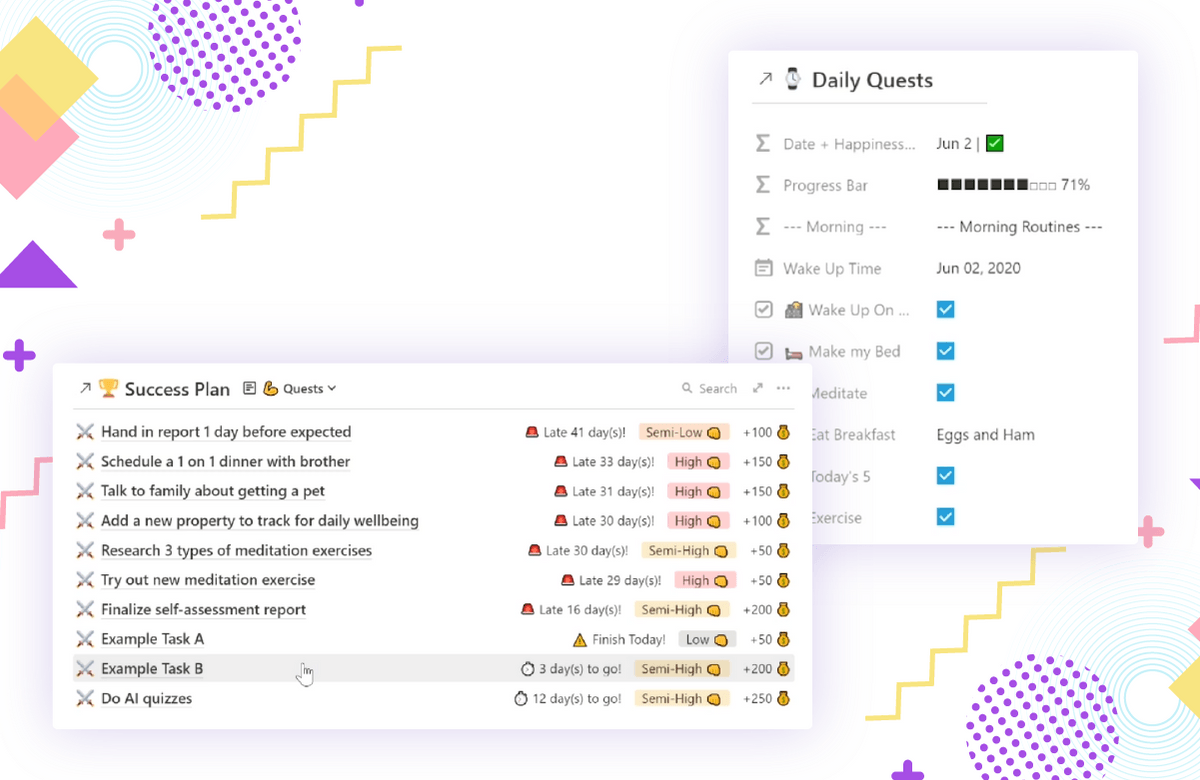
When managing systems became the job
Once storing everything got easy, a harder question showed up: what’s actually worth storing, and why? I got obsessed with intentionality, with always knowing the why, the what, and the how behind whatever I was doing. So I built Be Intentional, a life framework built around exactly that: a daily journal, a success plan, personal knowledge management, relationship tracking, more than twenty databases in all, meant to keep me focused on what mattered.
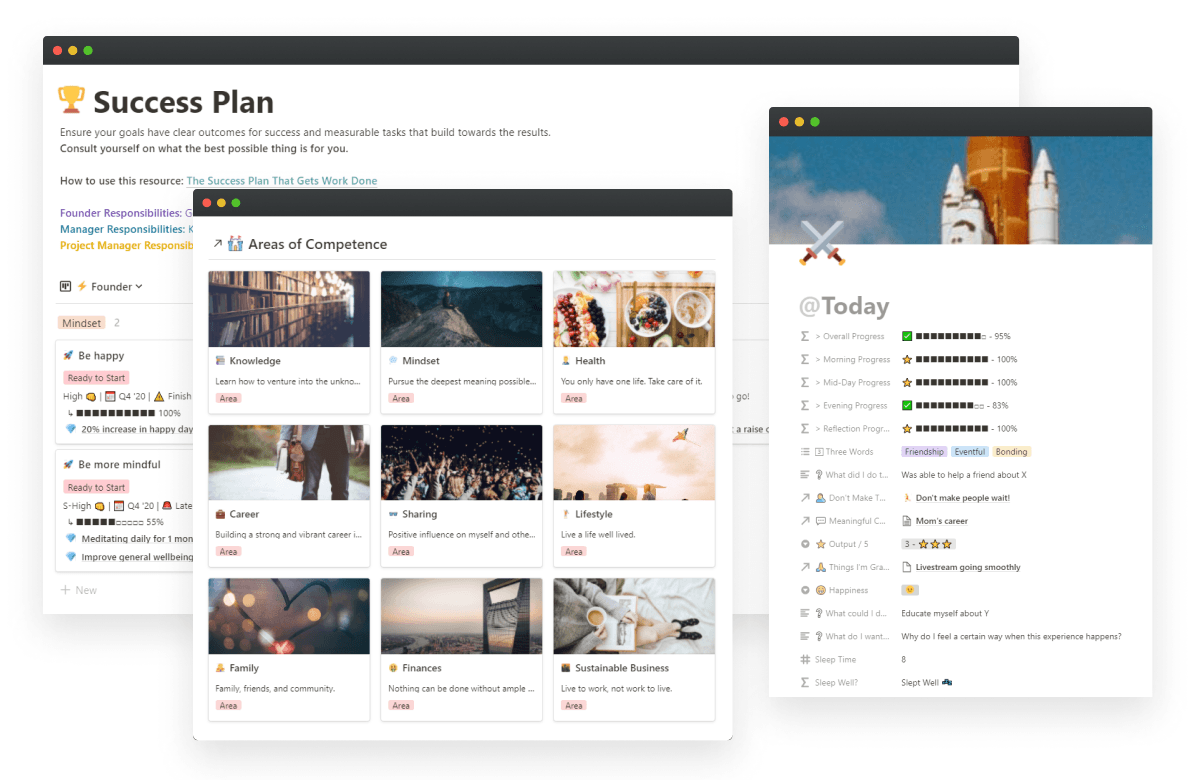
And this is where it quietly turned on me. Managing that many databases became a full-time job of its own. The more I tracked, the more there was to keep track of. The system only felt valuable if I kept it perfectly current with my every move, so I did. And because I was the one who built it, I was the only one who really knew how much was left to do. I’d sit down to work and end up agonizing over the shape of the system instead of doing the thing it was built for. I ended up setting aside separate days just to plan, and separate days to execute, as if the system were a second job I had to clock into before I could get to the first one.
When the system scaled out of control
Eventually I packaged what I’d learned into a template, L-CTRL, a way to take back control of your day: everything you were already tracking, plus real review cycles. It caught on fastest with businesses, teams who wanted to run their whole operation together on it. That mirrored what was happening at Co-x3 at the same time. We were scaling, with more co-creators, collaborators, and contributors every month, and a shared workspace was genuinely useful for keeping everyone aligned.
But we hit the same wall every growing team hits. Permissions weren’t granular. Every node in our org needed three tiers of access, and those tiers had to extend both up and down the structure, not sit flat.
| Tier | Who they are | What they needed, and why |
|---|---|---|
| Co-Creators | Creators building new programs and solutions for the community | Full control of their program’s nodes, extending down through everything inside, because they own the direction |
| Collaborators | Members committing regular time and skills to support programs | Edit access on the nodes they support, with visibility into surrounding nodes for context |
| Contributors | Members making one-off or occasional contributions | Access to just the node they’re contributing to, because they shouldn’t have to see (or break) anything else |
We had to pre-create every group by hand, and when someone’s role shifted, untangling their access became its own project. Notion hands out permissions in broad strokes rather than row by row, so people could see and change things they had no business touching. And we weren’t small: our adventurer program brought hundreds of new people into the workspace every single day. At that scale it stopped being an annoyance and became unbearable. The workspace got slow and cluttered, and just teaching someone new how to find their way around it took real effort.
Nothing stayed in sync, either. At Our Family Without Borders we needed what was essentially the same members database repeated across different homes. Every time one changed, someone had to carry the update to the others by hand. There was no sync. There was just remembering, and hoping you did.
How AI changes the game
Through all of it I was genuinely excited about what AI might do here, and one thing became clear. The part these tools had always been good at, staying organized and holding context for everyone, still worked. What never worked, no matter how carefully I designed the system, was the maintenance and the execution. Keeping it alive, and actually pushing the work through it, was still entirely on me.
That’s the part that actually changes now. Not the organizing; we mostly had that. The doing. When something can take on real, ongoing responsibility inside the system, tending it and running it stop being the same job. You stop being the only person who can operate your own machine, because you’re no longer the only one operating it.
Why Masterforce?
That’s the whole idea behind Masterforce. People set the direction and own the judgment calls. A force of masters, human and AI, carries real responsibility inside the actual structure of the work, not as a chatbot bolted onto the side, and not as a replacement for the people. It’s the system I wish I’d had ten years ago, and the best way I’ve found for anyone building something real to set down their goals and trust that things will actually keep moving.
Part of that belief is also just reassurance. Jumping to a new tool is scary, and it’s scary for a real reason: it’s historically been hard to get your data back out once you put it in. That’s part of why Obsidian became so popular. Everything just lives on your machine, genuinely yours, nothing to export because there’s nowhere else for it to live. I think that instinct is exactly right. Obsidian just isn’t AI-native, though, and it’s still not easy for most people to actually build with. Our community even built a plugin porting the success plan over to Obsidian. But I kept coming back to the same thought: something like this should exist, one that’s actually easy to build in, that can run entirely on your own machine, and that you can check out of any time because you were never locked in to begin with.
Masterforce is the way I’ve always wanted to interact with whatever’s cutting edge in AI, without needing to be technical about it. New models, new skills other people build, new agents, new tools to connect, you take advantage of all of it inside Masterforce instead of manually piping things together. Gone are the days of hand-wiring workflows in n8n or Zapier just to get two tools talking. And if privacy matters more to you than convenience, you run it all on your own machine and keep full sovereignty over your data. Freedom to use whatever you want, however you want, that’s really the whole idea.
Free early access is open, if you’d like to try it.